Gundalow Piscataqua sailing on the Piscataqua River between Kittery, ME and Portsmouth, NH at 5:00 pm October 7, 2022, painted October 21, 2022 10" x 8" (w x h), Daniel Smith, Schmincke Horadam, and Winsor & Newton watercolors, selected for light fastness and permanence, and Uniball waterproof fade proof ink on 140 lb. Fabriano Artistico cold press rough 100% cotton extra white watercolor paper, framed.
$300
Friday, October 28, 2022
Breeze on the Piscataqua
Watercolor Sails Sailing Essay
Watercolor Sails Sailing
How noted watercolor artists paint sailboats.
All of these watercolor artists approach their paintings differently from my watercolor.
Can you spot what's different? (Answer below)
1
Three Scudding Sailboats
Charles Sydney Hopkinson (1869-1962), American
Watercolor on paper, circa 1935-1940
Cape Ann Museum, Gloucester, MA
Charles Sydney Hopkinson (1869-1962) was an American portrait painter and landscape watercolorist. He maintained a studio in the Fenway Studios building in Boston from 1906 to 1962. He was one of the most successful and sought after portrait painters in America during the first half of the 20th century. He was the house portraitist at Harvard University. Among his sitters were Oliver Wendell Holmes, Calvin Coolidge, Lewis Perry and John Masefield. In the course of his 60 year career he created more than 700 portraits including two of United States presidents, four of Supreme Court Justices and 65 of university presidents, deans and professors. He was also part of the team of artists selected by the National Art Committee in 1919 to paint portraits of the delegates to the Versailles Peace Conference.
Watercolor was a medium that Hopkinson experimented with and enjoyed throughout his career. Working outdoors with rapid, broken brushstrokes, Hopkinson's watercolors are direct and spontaneous, fresh reactions to the scene around him. While his compositions can seem deceptively simple, each was thoughtfully conceived and painted with careful attention to depth and perspective.
Southend - The Pleasure Yacht
James McNeill Whistler (1834-1903), American
Watercolor on paper, 14" x 17" (w x h), circa 1882-1884
Smithsonian national Museum of Asian Art, Washington, D.C.
Born in Lowell, Massachusetts, Whistler studied in Paris and eventually moved to London. He learned watercolor technique as a boy and occasionally used it for preparatory studies early in his career, says Lee Glazer, director of the Lunder Institute for American Art at Colby College. "But despite the tremendous popularity of watercolor in the British art world, and Whistler's ultimate desire for success within that art world, he never seriously embraced watercolor until the 1880s."
That's when he painted this and others in the Southend of London, historically a rural village at the south of the parish of Lewisham, Kent. During the time Whistler painted his 1880s watercolors it remained undeveloped until after the First World War. It's now a residential suburb, with some large retail stores, within the built-up area of London.
3
Two Sailboats
Winslow Homer (1836–1910)
Watercolor, gouache and graphite on paper, 17" x 8" (w x h), 1880
Philadelphia Museum of Art, Philadelphia, PA
Homer's skill as a watercolor painter grew during his second long sojourn in Gloucester, Massachusetts, in the summer of 1880, when his work became breathtakingly fluid and impressionistic. Exploiting the texture of the paper and the range of transparency in his pigments, Homer used techniques like scraping to add highlights to his boldly simplified compositions.
4
Racing Sails
Milton Avery (1885-1965), American
Watercolor, transparent and opaque, and graphite paper,
35" x 23" (w x h), 1960
Whitney Museum of American Art, New York, NY
"He was, without question, our greatest colorist. ... Among his European contemporaries, only Matisse—to whose art he owed much, of course—produced a greater achievement in this respect." - Art critic Hilton Kramer
5
A Boat near Santa Marta, Venice
Joseph Mallord William Turner (1775-1851), British
Watercolor on paper, 13" x 9" (w x h), 1840
Tate Museum, London, England
In August 1840 Turner crossed the Channel to Rotterdam, and travelled up the Rhine on what was to be his last journey to Italy, the country that had inspired so much of his work. His destination was Venice, where he arrived on August 20th. Venice was then a city of crumbling palaces, fitting Turner's typically Romantic fascination with the decline of once great civilizations. He spent two weeks in the city, staying at the Hotel Europa. He made an extensive series of richly colored watercolors of every part of this serene city. They show Venice under a variety of atmospheric conditions, from the haziness of dawn to the crisp sunlight of midday, and finally the coloring of twilight and the setting sun.
Editor and critic Charles Lewis Hind wrote that it showed "the way [Turner] worked, when painting for his own pleasure, not for exhibition – green water, violet hills, rosy buildings held together by the strength of that tawny sail – lovely."
6
Venice
George Elbert Burr (1859-1939) American
Watercolor and pencil on paper, 9" x 6" (w x h), 1900
Smithsonian American Art Museum
George Elbert Burr is considered one of the finest of the early 20th-century American etchers. His prints are in a number of prominent collections including the Smithsonian American Art Museum, the British Museum, the French National Print Collection, Luxembourg Gallery, Victoria and Albert Museum, the New York Public Library, Brooklyn Museum, Museum of Northern Arizona. and the Congressional Library in Washington, D.C.
7
Sailboat
Edward Hopper (1882-1967), American
Watercolor and graphite on paper,
4" x 5" (w x h), circa 1900
Whitney Museum of American Art, New York, NY
Edward Hopper graduated from Nyack High School in 1899. The next year he painted this sailboat. In school he'd dreamed of being a naval architect, but after graduation he declared his intention to follow an art career. Hopper's parents insisted that he study commercial art to have a reliable means of income. In developing his self-image and individualistic philosophy of life, Hopper was influenced by the writings of Ralph Waldo Emerson. He later said, "I admire him greatly...I read him over and over again."
Hopper began art studies with a correspondence course in 1899. Soon he transferred to the New York School of Art and Design, the forerunner of Parsons School of Design. There he studied for six years.
8
Idle Sails
John Singer Sargent (1856-1925), American
Watercolor and graphite on paper, 21" x 14" (w x h), 1913
Metropolitan Museum of Art, New York, NY
Sargent painted more than 2,000 watercolors, from the English countryside to Venice to the Tyrol, Corfu, the Middle East, Montana, Maine, and Florida. Each destination offered pictorial stimulation and treasure. Even at his leisure, in escaping the pressures of the portrait studio, he painted with restless intensity, often painting from morning until night. In the last decade of his life (1915-1925), he produced many watercolors in Maine, Florida, and in the American West, of fauna, flora, and native peoples.
His late works suggest Sargent painting purely for himself. His watercolors were executed with a joyful fluidness. He also painted extensively family, friends, gardens, and fountains. This watercolor, Idle Sails, was inherited by his sisters, Mrs. Francis Ormond (Violet Sargent) donating it to the Metropolitan Museum of Art upon in 1950.
Sargent's first major solo exhibit of watercolor works was in 1905 in London. In 1909, he exhibited eighty-six watercolors in New York City, eighty-three of which were bought by the Brooklyn Museum.
In 1927 Evan Charteris wrote: "To live with Sargent's watercolors is to live with sunshine captured and held, with the luster of a bright and legible world, the refluent shade and the ambient ardors of the noon."
Answer:
All of these watercolor artists painted their sailboats from afar. They painted as observers and not participants of sailing. None of them painted their watercolors from the perspective of being aboard a sailboat, as I did. Surprisingly, few artists choose the sailing perspective from aboard a sailboat.
Tuesday, October 25, 2022
Steady on the Piscataqua
Captain at the helm on the Gundalow Piscataqua sailing on the Piscataqua River between Kittery, ME and Portsmouth, NH, October, 2022 7" x 5" (w x h), Daniel Smith, Schmincke Horadam, and Winsor & Newton watercolors, selected for light fastness and permanence, and Uniball waterproof fade proof ink on 140 lb. Fabriano Artistico cold press rough 100% cotton extra white watercolor paper, framed.
$150
-or fundraising through the Gundalow Company, 60 Marcy Street, Portsmouth, NH 03801.
Saturday, October 22, 2022
Catching the Sun
Lateen gundalow sailing on the Piscataqua River Kittery, ME and Portsmouth, NH at 5:00 pm October 7, 2022, painted October 21, 2022 10" x 8" (w x h), Daniel Smith, Schmincke Horadam, and Winsor & Newton watercolors, selected for light fastness and permanence, and Uniball waterproof fade proof ink on 140 lb. Fabriano Artistico cold press rough 100% cotton extra white watercolor paper, framed.
$300
-or fundraising through the Gundalow Company, 60 Marcy Street, Portsmouth, NH 03801.
Piscataqua on the Piscataqua
Lateen gundalow sailing between Kittery, ME and Portsmouth, NH October 7, 2022, painted October 21, 2022 7" x 5" (w x h), Daniel Smith, Schmincke Horadam, and Winsor & Newton watercolors, selected for light fastness and permanence, and Uniball waterproof fade proof ink on 140 lb. Fabriano Artistico cold press rough 100% cotton extra white watercolor paper, framed.
$150
-or fundraising through the Gundalow Company, 60 Marcy Street, Portsmouth, NH 03801.
Tuesday, October 18, 2022
Stóri Dímon in Markarfljót 1
in
Iceland on September 1, 2022, painted September 25, 2022, 7" x 5" (w x
h), Daniel Smith, Schmincke Horadam, and Winsor & Newton
watercolors, selected for light fastness and permanence, and Uniball
waterproof fade proof ink on 140 lb. Fabriano Artistico cold press rough
100% cotton extra white watercolor paper, framed.
$175 - SOLD
Stóri Dímon in Markarfljót 2
in Iceland on September 1, 2022, painted September 25, 2022, 10" x 8" (w x h), Daniel Smith, Schmincke Horadam, and Winsor & Newton watercolors, selected for light fastness and permanence, and Uniball waterproof fade proof ink on 140 lb. Fabriano Artistico cold press rough 100% cotton extra white watercolor paper, framed.
$300
Friday, October 7, 2022
Stóri Dímon in Markarfljót
Art of Grandfather and Grandson with poem
Stóri Dímon in Markarfljót Study 3
in Iceland on September 1, 2022, painted September 25, 2022 10" x 8" (w x h), Daniel Smith, Schmincke Horadam, and Winsor & Newton watercolors, selected for light fastness and permanence, and Uniball waterproof fade proof ink on 140 lb. Fabriano Artistico cold press rough 100% cotton extra white watercolor paper, framed.
$300 - Private Collection
Stóri Dímon in Markarfljót Monochrome
(Grandson) Finn McMillan (Oct 8, 2002 - ), American-Swiss
Watercolor on paper, 7" x 5" (w x h)
Private Collection
Full Color as Monochrome
2
Finn's desire was to paint this in black and white as a watercolor. I showed him how to paint this as in black and white, while using full color, and he did. He used Burnt Sienna and French Ultramarine together to paint warm blacks and Paynes Gray Bluish and Quinacridone Purple to paint cool blacks, which are subtly seen in the art.
3
Finn walking by Stóri Dímon on the flat black river valley before painting.
Photo of Stóri Dímon in the wide Markarfljót river valley on September 1, 2022.
4
Colors Still There
by Bruce McMillan
On a wide, flat plain
of stone black lava,
a peak withstood
a glacial till stream
through time, to stand tall
in sun, all good.
We discover it
again, again, with
the likelihood
that painters could sketch
and paint this icon,
as many would,
generations of
painters, in colors
they understood.
All text, photos and art © 2022 Bruce McMillan
Friday, September 23, 2022
Hurricane Earl Surfs Marginal Way
Surfs Marginal Way
painted at the Perkins Cove Plein Air Event, in Ogunquit, Maine on September 10, 2022 10" x 8" (w x h), Daniel Smith, Schmincke Horadam, and Winsor & Newton watercolors, selected for light fastness and permanence, and Uniball waterproof fade proof ink on 140 lb. Fabriano Artistico cold press rough 100% cotton extra white watercolor paper, framed.
$300
Saturday, September 17, 2022
High Tide Perkins Cove
Painted at the Perkins Cove Plein Air Event, in Ogunquit, Maine on September 10, 2022 14" x 11" (w x h), watercolor and ink on rough watercolor paper, framed, $500 USD for sale at my art blog, theartofbruce.blogspot.com
The scene that day while painting.
Watercolor Artists...Red...Essay
~ ~ ~ ~ ~ ~ ~ ~ ~ ~
Watercolor Artists
Approach Red Buildings
Visual Essay
featuring watercolors of
Richard Sargent, Georgina Klitgaard,
Edward Hopper, Charles Demuth,
Thomas Hart Benton, and
William Traylor
1
Red House
Richard Sargent (1911-1978) American
Watercolor on paper, 10" x 14" (w x h)
Smithsonian American Art Museum, Washington D.C.
Richard Sargent, born in Moline, Illinois in 1911, received his art education at the Corcoran School of Art and the Philips Memorial Gallery in Washington, D.C. He also worked with Ben Shahn. Sargent painted many cover paintings for The Saturday Evening Post. His illustration works are feature good humor and insight into human frailties. He also illustrated for Fortune, Woman’s Day, American Magazine, Photoplay, and Collier’s magazine. He was a member of the Society of Illustrators in New York, and for many years, lived and painted in Spain.
2
Ice House, Nantucket
Georgina Klitgaard (1889/1893-1977) American
Watercolor, graphite and charcoal on paper, 20" x 14" (w x h), 1930
Whitney Museum of American Art, New York
Georgina Klitgaard (born Berrian), an American artist, was known for panoramic landscape paintings of scenic New York from a bird's-eye view perspective. Her work was reviewed in the Los Angeles Times, on April 14, 1929, and in The Art Digest, on November 1, 1929. She painted three murals in United States Post Offices during the Great Depression. She graduated from Barnard College, and also studied art at the National Academy of Design.
3
Cobb's Barns and Distant Houses
Edward Hopper (1882-1967) American
Watercolor and graphite on paper, 30" x 22" (w x h), 1931
Whitney Museum of American Art, New York
Edward Hopper was renting Burly Cobb's house when this was painted during the Depression. It's in South Truro, Cape Cod, Massachusetts. Hopper sold 30 paintings in 1931, including 13 watercolors. The following year he participated in the first Whitney Annual, and he continued to exhibit in every annual at the museum for the rest of his life. In 1933, the Museum of Modern Art gave Hopper his first large-scale retrospective.
4
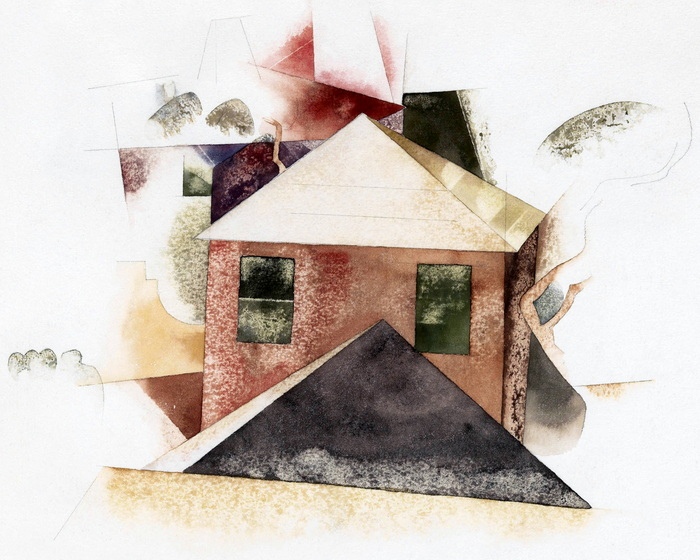
Houses with Red
Charles Demuth (1883-1935) American
Watercolor and graphite on paper, 14" x 10" (w x h), 1917
The MET Art Museum, New York, New York
Charles Demuth (1883-1935) was one of the leading artists during the American Modernism era. He was distinguished for intimate watercolors and cubic architectural paintings. Demuth studied art at Académie Julian in Paris, where he was welcomed into the avant-garde art scene and met other American Cubism artists like Marsden Hartley. He illustrated plays and novels such as Émile Zola's Nana. Demuth later employed a cubist technique by painting industrial factories with complex structural planes, leading him to becoming a pioneer for the Precisionist movement.
5
House in Cubist Landscape
Thomas Hart Benton (1889-1975) American
Watercolor and charcoal on paper, mounted on board,
8" x 12" (w x h), circa 1915-1920
Whitney Museum of American Art, New York, New York
Thomas Hart Benton was at the forefront of the Regionalist art movement. His work is strongly associated with the Midwestern United States, the region in which he was born and which he called home for most of his life. He also studied in Paris, lived in New York City for more than 20 years and painted scores of works there. He summered for 50 years on Martha's Vineyard.
6
Man in Blue House with Rooster
Bill Traylor (1853-1949) American
Opaque watercolor and graphite pencil on board,
12" x 16" (w x h), circa 1939-42
Whitney Museum of American Art, New York
William Traylor was an African-American self-taught artist from Lowndes County, Alabama. Born into slavery in 1853, Traylor spent the majority of his life after emancipation as a sharecropper. It was only after 1939, following his move to Montgomery, Alabama, that Traylor began to draw. At the age of 85, he took up a pencil and a scrap of cardboard to document his recollections and observations. From 1939 to 1942, while working on the sidewalks of Montgomery, he produced nearly 1,500 pieces of art. Traylor now holds a central position in the fields of self-taught-artists and modern art.
Thursday, September 15, 2022
Morning Tide Marginal Way
with the rising sun over surf from Hurricane Earl, painted at the Perkins Cove Plein Air Event, on September 10, 2022 14" x 11" (w x h), Daniel Smith, Schmincke Horadam, and Winsor & Newton watercolors, selected for light fastness and permanence, and Uniball waterproof fade proof ink on 140 lb. Fabriano Artistico cold press rough 100% cotton extra white watercolor paper, framed.
$500
The plein air setup
Sea and Sun 6 Artists Essay
~ ~ ~ ~ ~ ~ ~ ~ ~ ~ ~ ~ ~
Watercolor Sea and Sun
by Six Artists Essay
Fairfield Porter, Joseph Mallord William Turner,
Violet Oakley, Martin Mower, John Marin,
and Wendy Klemperer
How watercolor artists
paint a body of water and sun
while looking directly into the sun
during sunrise.
1
Sunrise
Fairfield Porter (1907-1975) American
Watercolor and graphite on paper,
22" x 30" (w x h), circa 1974-1975
From Hirschl and Adler Gallery:
Fairfield Porter did his best work during the last fifteen years of his life. His style loosened somewhat, and he incorporated more abstract forms and colors and recorded a freer and more immediate impression of his subjects. In his lifelong pursuit of realistic, non-abstract subjects, however, Porter was far ahead of his time, particularly in painting portraits of his family and friends, a genre that wasn't taken seriously by the art world until years later.
Sunrise is one of three studies done in preparation for Porter's color lithograph Sunrise. It's an impressionistic view of the sea and sky taken from the beach near Porter's Southampton home.
2
Sunrise: Whiting Fishing at Margate
Joseph Mallord William Turner (1775-1851) English
Watercolor on paper, 20" x 15" (w x h), 1822
Tate Museum, London, UK
Tate catalogue (edited):
"Although described by Finberg as a sunset, this atmospheric color of the sun low over the sea has been tentatively linked by Eric Shanes to the 1822 watercolor Sunrise, Whiting Fishing at Margate (private collection). The sun in the finished composition is noticeably off-center to the left, clear of the cliffs occupying the right-hand half of the horizon, and Turner seems to be experimenting with a variation in asymmetrical placement."
3
Study of Sun and its Reflection on Lake George
Violet Oakley (1874-1961)-American
Watercolor on paper
Woodmere Art Museum, Philadelphia, Pennsylvania
Gift of the Pennsylvania Academy of the Fine Arts, 2015
From Woodmere Art Museum (edited):
Violet Oakley (1874-1961), during the American Renaissance, a period of cultural renewal at the turn of the twentieth century, was the most renowned woman in the cultural life of the country, achieving international fame when she was commissioned to create a monumental series of murals in the new Pennsylvania State Capitol. The Philadelphia Public Ledger asserted that "the history of art in America probably records no greater distinction awarded to a woman than the selection of Miss Oakley to perform so important a work."
At a time when women artists usually concentrated on domestic themes, a prominent art critic observed that... "[Oakley's] vision of life moved outward in ever-widening circles, embracing the striving of all men and women..."
Oakley, a role model for aspiring female professionals for two decades before women won the right to vote, supported higher education for women by designing works of art for Bryn Mawr College, Vassar College, and Sarah Lawrence College. She was the second woman appointed to the faculty of the Pennsylvania Academy of the Fine Arts. In her later years she fashioned a role for herself as an activist promoting gender and racial equality, international government, and world peace. She drew portraits of the delegates to the League of Nations and the United Nations. Admired as a public intellectual as well as an artist, she was awarded an honorary doctorate in Literature from Delaware College in 1918, and an honorary doctorate in Law from Drexel University in 1948.
4
Sun Spots (Stonington, Maine)
John Marin (1870-1953) American
Watercolor and charcoal on paper, 20" x 17" (w x h), 1920
Metropolitan Museum of Art, New York, New York
From John Marin Part 1, A Stylistic Analysis by Sheldon Reich, University of Arizona Press, Tucson, 1970 (edited):
John Marin spent the summer of 1920 in Stonington... The motif of the sun had always obsessed Marin... [The sun spots] are like a the after-image caused by staring into too long into a brilliant sun... Stylistically, the most significant factors in Sun Spots are a clarity and simplicity of composition... Sun Spots... a Maine landscape, is a relatively abstract statement by Marin.
5
Nahant Shore /
Seascape, Mahomet Shore (Massachusetts)
Martin Mower (1870-1960) American
Watercolor and graphite on paper, 7" x 5" (w x h), circa 1896
Harvard Art Museums/Fogg Museum, Cambridge, MA
Martin Mower, born in Lynn Massachusetts, painted in oil and watercolor and pastel. He sketched drawings, as well as worked in stained glass and photography. He was a friend of Isabella Stewart Gardner, who included nine Martin Mower paintings and drawings in her Isabella Stewart Gardner Museum, Boston. Also included in the ISG displays is some of their correspondence from 1923 with a mention of Martin's wife. "Dearest Mrs. Gardner, Evelyn and I are immeasurably cheered and delighted by the gift from you..." Martin and his wife, Evelyn Mower, lived at 6 Craigie Circle, Cambridge, Massachusetts. He died at 90-years-old in Vancouver, British, Columbia, Canada.
6
The Ship, Seascape #4
Wendy Klemperer (1958- ) American
Watercolor on paper, 2019
Wendy Klemperer earned a bachelor's in biochemistry at Harvard before moving to NYC to pursue art full time, earning a B.F.A. in sculpture at Pratt Institute in 1983. She's an accomplished metal sculptor.
In 2019, she was an artist at sea with a scientific research team at the University of New Hampshire. Her three-week artist residency at sea led to pencil sketches of the crew members highlighting the collaborative nature of scientific research, and her watercolors of the sea and ocean life celebrated the scientific and experiential rewards of conducting environmental research outdoors. Her watercolors from her time aboard the ship were displayed at the UNH Museum of Art.
Wendy Klemperer was born in 1958 in Boston, and raised in Cambridge and Watertown. She explored her passion for animals and nature during summers spent at her grandmother's country house in New Hampshire. Her sculptures are exhibited across the United States. While doing this essay I realized I've driven by a sculpture of hers on the way to Maine Audubon, and osprey and nest on Martin's Point Bridge in Falmouth, Maine. Wendy Klemperer lives in Brooklyn, NY and Nelson, NH.
Wendy Klemperer's website is HERE.
Friday, September 9, 2022
Path to the East Point Sea
at Maine Audubon's East Point Sanctuary in Biddeford Pool, Maine, painted plein air August 16, 2022, 7" x 5" (w x h), Daniel Smith, Schmincke Horadam, and Winsor & Newton watercolors, selected for light fastness and permanence, and Uniball waterproof fade proof ink on 140 lb. Fabriano Artistico cold press rough 100% cotton extra white watercolor paper, framed, value $150, painting donated to the 2022 Brush with Nature: Plein Air Event and Art Auction 2022
The East Point of Tidal Pool Seaweed
of Tidal Pool Seaweed
at Maine Audubon's East Point Sanctuary in Biddeford Pool, Maine, painted plein air August 20, 2022, 7" x 5" (w x h), Daniel Smith, Schmincke Horadam, and Winsor & Newton watercolors, selected for light fastness and permanence, and Uniball waterproof fade proof ink on 140 lb. Fabriano Artistico cold press rough 100% cotton extra white watercolor paper, framed, value $150, painting donated to the 2022 Brush with Nature: Plein Air Event and Art Auction 2022
Goldenrod East Point
at Maine Audubon's East Point Sanctuary in Biddeford Pool, Maine, painted plein air August 20, 2022, 5" x 7" (w x h), Daniel Smith, Schmincke Horadam, and Winsor & Newton watercolors, selected for light fastness and permanence, and Uniball waterproof fade proof ink on 140 lb. Fabriano Artistico cold press rough 100% cotton extra white watercolor paper, framed, value $150, painting donated to the 2022 Brush with Nature: Plein Air Event and Art Auction 2022
Friday, September 2, 2022
Thingvellir Wishing Pool
Þingvellir Peningagjá
at the National Park in Iceland, Thingvellir, on August 28, 2022, painted August 31 / Sept 1, 2022 7" x 5" (w x h), Daniel Smith, Schmincke Horadam, and Winsor & Newton watercolors, selected for light fastness and permanence, and Uniball waterproof fade proof ink on 140 lb. Fabriano Artistico cold press rough 100% cotton extra white watercolor paper, framed.
$150
Thursday, August 25, 2022
East Point Tidal Pools
at the Maine Audubon East Point Sanctuary at Biddeford Pool, Biddeford, Maine, painted plein air August 20, 2022, 7.5" x 17.5" (w x h), Daniel Smith, Schmincke Horadam, and Winsor & Newton watercolors, selected for light fastness and permanence, and Uniball waterproof fade proof ink on 140 lb. Fabriano Artistico cold press rough 100% cotton extra white watercolor paper, framed.
Benefit Maine Audubon 2022 Brush with Nature Plein Air Event and Art Auction - the event HERE
The view east looking out to sea from the point at East Point
Saturday, August 20, 2022
Sea Scene Off Sand Beach
The view at low tide, Sand Beach, in Stonington, Maine, painted plein air August 4, 2022, 17.5" x 13.25" (w x h), Daniel Smith, Schmincke Horadam, and Winsor & Newton watercolors, selected for light fastness and permanence, and Uniball waterproof fade proof ink on 140 lb. Fabriano Artistico cold press rough 100% cotton extra white watercolor paper, framed.
$700
Watercolor Gallery Sand Beach
~ ~ ~ ~ ~ ~ ~ ~ ~ ~ ~ ~ ~ ~ ~ ~ ~
Watercolor Gallery Same View
Sand Beach, Stonington 1919-2015
These early 1900s watercolors, all documented as painted in Stonington, are likely Sand Beach, based on the views in the paintings, the ledges on the right side of the beach, that Sand Beach is the largest of the barely any sand beaches on the rocky coast in Stonington, and that John Marin ate at the Inn across from Sand Beach.
Sand Beach Shore
Jill Hoy (1954- ), American
Watercolor on paper, 30" x 23" (w x h), 2015
$2,000
Jill Hoy, B.F.A. University of California at Santa Cruz and attended the New York Academy of Art in New York City, lives in Stonington, Maine, Somerville, Massachusetts, and New York City. Because she's been a regular resident of the Deer Isle area since 1965, much of her work documents places and time here. The artist's website is HERE.
2
The Green Sea - Movement - Stonington, Maine
John Marin (1870-1953), American
Watercolor with wiping and charcoal on textured paper,
19" x 16" (w x h), 1921
Art Institute of Chicago
John Marin ate at the Inn facing Sand Beach in Stonington, the same building, the only house facing the beach, where our art group stayed to paint a few years ago.
In the summers John Marin painted in Stonington he wrote to Alfred Stieglitz in New York.
1921: This Stonington is a cussed place, but if someone were to tell me I couldn't come back here next year I'd be mad clear through. How do you account for that? Well, every place has its cussedness. And you would have to get its special cussedness all over.
1922: Stonington is about the same as ever, always at first disappointing. Then that wears away and you begin to like it all over again... While I work Mrs. Marin picks blueberries and gets the meals. It's all work up here.
1928: "I would be home, at home, in this place, these places my homes, all together my home. My loves, my home. If I am able to snare a bit of this in what I do, that's it."
3
The Sea, Maine
John Marin (1870-1953), American
Watercolor and charcoal on paper, 20" x 16" (w x h), 1921
Minneapolis Institute of Art
Museum notes:
In establishing his modernist style, John Marin frequently turned to the untamed landscape for his subjects, especially the landscape of Maine. The New Yorker visited Maine every year, spending the summer of 1921 in Stonington, a picturesque fishing village on the southern shore of Deer Isle, one of the many islands along Maine's coast. The Sea, Maine is a plein-air interpretation of the island's rugged shoreline of granite outcroppings and windswept pine and spruce. In this dynamic meeting of land and sea, Marin united abstract and representational impulses, using gestural strokes, bold colors, and delicate washes to denote nature's essential forms. His line and brushwork have an urgent, improvisational quality, conveying the rhythm and motion of wind and surf.
John Marin and his family summered in Stonington at the same time as William and Marguerite Zorach and their family. They were friends and socialized.
4
Stonington, Maine
William Zorach (1887-1966), Lithuanian-American
Watercolor on paper, 15" x 12" (w x h), 1919
William Zorach was a Lithuanian-born American sculptor, painter, printmaker, and writer. He won the Logan Medal of the arts. He is notable for being at the forefront of American Artists embracing cubism, as well as for his sculpture. He's the husband of Marguerite Thompson Zorach and father of Dahlov Ipcar, both artists in their own right. I was lucky enough to meet fellow children's boom author, Dahlov Ipcar. She was two years old when her father painted this watercolor in 1919.